


Condylin/Condyline (Podophyllotoxin) for Genital Warts: When It May Help—and When Laser Treatment Is the Better Choice
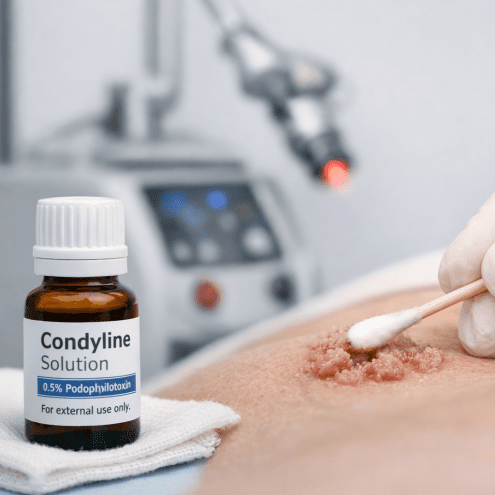
Many people search for “Condylin/Condyline” because they want a fast, practical solution for genital warts (condyloma). In evidence-based guidelines, podofilox/podophyllotoxin is listed as a patient-applied option for selected external anogenital warts, alongside other patient-applied and clinician-delivered treatments.
The most important point: the “right” approach depends on wart location, number, size/thickness, recurrence pattern, and your clinical situation.
This page explains
(1) what Condylin/Condyline-type treatment is,
(2) where it commonly fails or causes problems, and
(3) when clinician treatment such as laser/ablation becomes the more rational and safer option.
Medical disclaimer: Educational information only; it does not replace a clinical examination.
What is Condylin/Condyline (podophyllotoxin / podofilox) and how does it work?
Podofilox (podophyllotoxin) is a topical agent that destroys wart tissue. The CDC STI Treatment Guidelines list podofilox 0.5% solution/gel among patient-applied treatments for external anogenital warts.
When can podophyllotoxin be a reasonable option?
In practice, it can be considered when:
-
Warts are external and clearly identified as genital warts on examination.
-
Disease is limited (not widespread) and in a location suitable for safe self-application.
-
The patient can follow a structured plan and understands local reaction risks.
Guidelines emphasize that multiple modalities exist and the choice is individualized.
Common problems with “Condylin” self-treatment
Local tissue damage from misapplication
If topical medication spills onto healthy skin or is applied to the wrong area, it can cause marked irritation, erosions, and pain. A podofilox product monograph specifically warns to avoid undiseased skin and cautions against use on inflamed/irritated surrounding tissue.
Not for pregnancy
CDC guidance: podofilox/podophyllin/sinecatechins should not be used during pregnancy.
European/IUSTI guidance also states podophyllotoxin is contraindicated in pregnancy.
Wrong lesion, wrong location, or “too much disease”
When warts are extensive, thick/keratinized, recurrent, or located in areas that require specialist assessment, topical self-treatment may be ineffective or unsafe, and clinician treatment becomes more appropriate.
When laser/ablation is often the better choice
Laser (and other clinician-delivered options such as electrosurgery, excision, cryotherapy, acids) is commonly preferred when there is:
-
Extensive / multiple warts
-
Recurrent or treatment-resistant disease
-
Thick / keratinized lesions
-
A need for faster clearance under clinician control
-
Locations where precise, controlled treatment is important
The BASHH 2024 guideline lists clinician-delivered options including laser, electrosurgery, cryotherapy, and surgical excision (depending on site).
Will it come back after treatment?
Recurrence can happen with any approach. The treatment goal is to remove visible lesions and then manage recurrence risk with follow-up and preventive counselling. European guidance covers diagnosis, treatment, follow-up, and patient advice in a structured way.
Our clinical approach (Tirana)
-
We start with an examination to confirm diagnosis and map wart distribution.
-
If a topical option is appropriate, we discuss it with clear safety boundaries.
-
If warts are widespread, recurrent, thick, or in a difficult location, we typically prioritize clinician-delivered removal (laser/ablation) with an individualized aftercare plan.
Frequently asked questions (FAQ)
Is Condylin/Condyline “wrong” for genital warts?
Podofilox/podophyllotoxin is included in major guidelines as a patient-applied option for selected external anogenital warts. It becomes a poor choice when the diagnosis is uncertain, the area is unsuitable, reactions are severe, or disease is extensive/recurrent.
Why did my skin burn or ulcerate?
Local reactions can occur, especially if medication touches healthy skin or is applied to inflamed tissue; product information emphasizes immediate washing if spilled on undiseased skin and avoiding use when surrounding tissue is irritated.
Is laser “more definitive”?
Laser can be more efficient for extensive or difficult warts and enables controlled removal, but recurrence can still occur—follow-up remains important.
H3: Who should avoid podophyllotoxin?
Pregnant patients should not use it; suitability also depends on location and local skin condition.
Contact & Appointments
For appointment requests or medical inquiries, please contact us using the options below.
📞 Clinic Phone (Office Hours)
+355 69 836 1565
Available Monday–Saturday, 09:00–16:00.
💬 WhatsApp (Outside Office Hours)
+355 69 456 4467
Available outside office hours via WhatsApp Message only.
Author: Asst. Prof. Eser Ağar, MD — Obstetrician and Gynecologist
This page is for informational purposes and does not replace examination and physician evaluation.
Medically reviewed: Asst. Prof. Eser Ağar, MD —
 Call Now
  WhatsApp


